
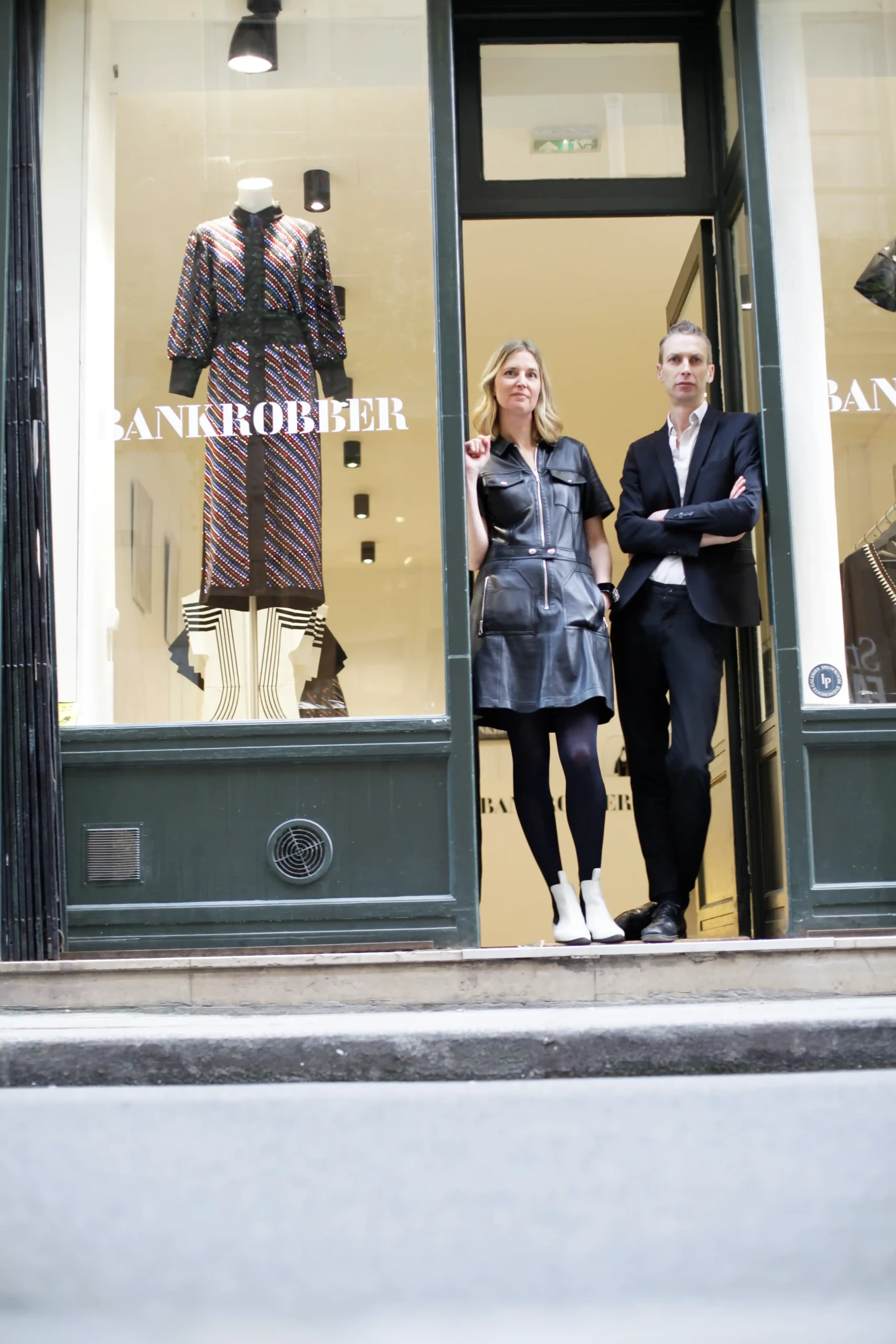
Founded in 2025 in Paris by German designer Sabine Dreher and English marketing director partner John Hughes, Bankrobber is a womenswear label built on bold simplicity and rebellious elegance. Defined by geometric silhouettes, monochrome palettes, and structural precision, the brand reimagines modern femininity as strong, self-possessed, and unapologetically independent.
Producing highly limited collections crafted from sustainable, high-quality materials, Bankrobber rejects fashion’s conventional rules in favor of clarity, restraint, and attitude. Since its launch, the brand has gained attention through editorial features, cultural collaborations, and Paris pop-ups, establishing a design language rooted in dark elegance, brutalist influence, and the enduring spirit of the “eternal outlaw.”
Bankrobber @bankrobberparis www.bank-robber.com
Bankrobber is a striking name for a womenswear brand. What does the idea of the “outlaw” mean to you, and how does it shape the world you’re building through the clothes?
Bankrobber is a name that we fell upon, really. We had others that felt right—based on ideas of stripping back and simplicity—Bankrobber doesn’t actually relate that idea. It came from the Clash song of the same name, by accident. We also nod to The Clash on our site—and particularly the photos of Pennie Smith, which I loved growing up, often before I knew all The Clash songs—just because they were so dark, bold and stylish.
That accident has been a happy one for us, shaping both our aesthetic and how our audience sees us. People often smile at the name, for some it feels rebellious and mythical—think Butch Cassidy or Bonnie and Clyde. It’s also one-dimensional, like a cartoon of rebellion, even though real bankrobbers could be violent and killed people. The recent Louvre robbery showed how the idea of an audacious robbery fascinates people, with disbelief and wonder. It was literally daylight robbery.
Babkrobber is about being beyond the law. Being made free by committing a crime, but always on the run.You can never rest. For us, it means not playing by fashion’s rules — seasons, styles, feminine or masculine. We want to move beyond labels and design on our own terms.
Competing with us for traffic on Google is a website that shows an FBI wanted list of actual bankrobbers in the USA. The truth looks a little less glamorous, because it always is.
You describe your aesthetic as bold simplicity and rebellious elegance. How do you personally define elegance today, and why did rebellion feel essential to include in that definition?
I don’t think elegance is one thing. I definitely don’t think it comes from the price tag on your clothes. Elegance is how you carry yourself. What you believe in and how you treat others. For Bankrobber, with our clothes – we have also spoken about ‘dark elegance’ – in the latest collection. I would say that the clothes have an attitude. You’re not going to wear them everyday. There will be a reason. We’ve had people try them on and be really surprised by how they fit, but also how bold they are and they start to carry themselves differently. That’s one of the most exciting parts to it.
Simplicity is often misunderstood as minimalism. For Bankrobber, what makes simplicity deliberate rather than reductive?
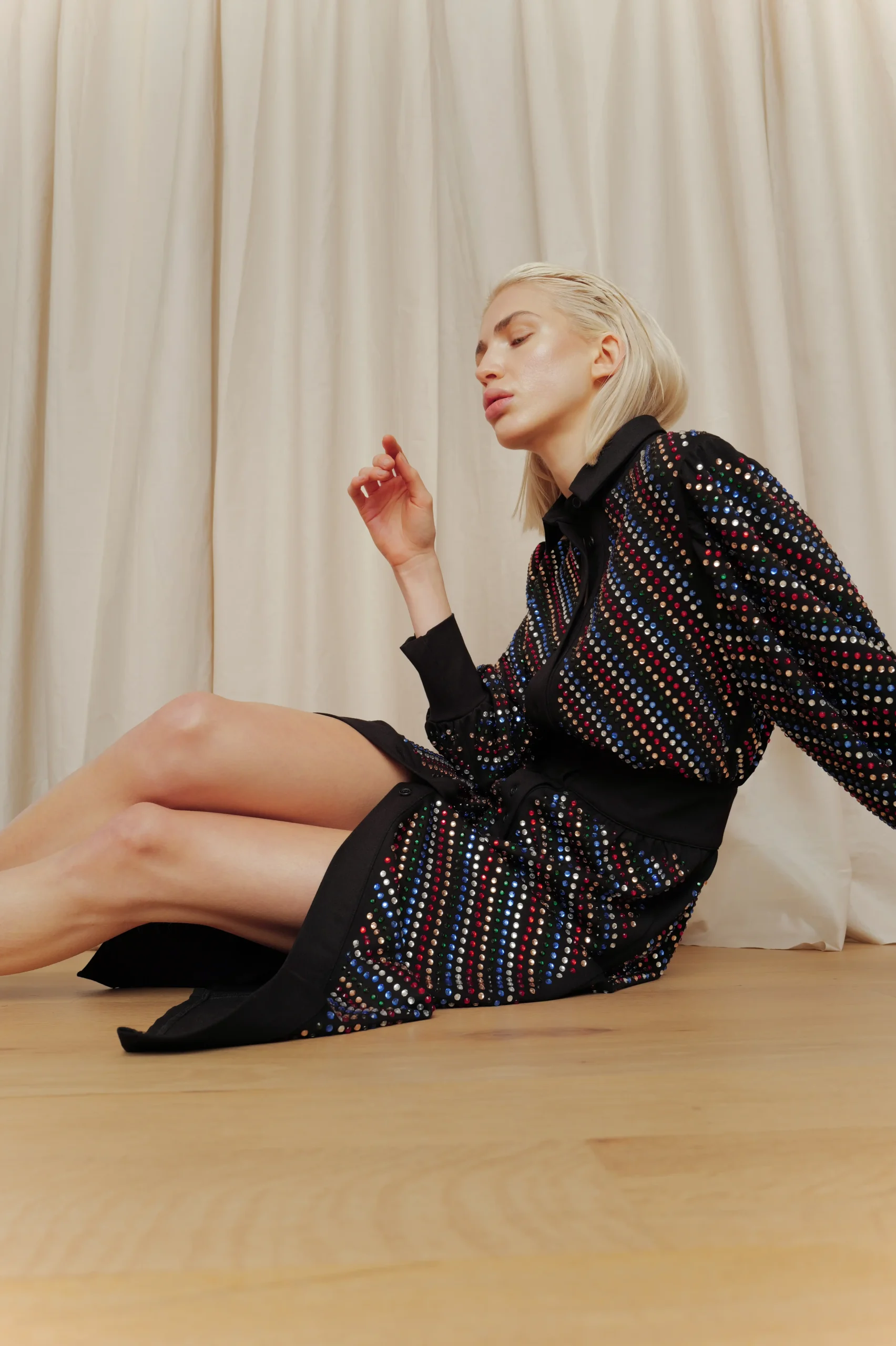
The new collection is only black dresses, they are studded, or have flashes of colour or cut-outs to contrast. Within that, we do think of them as minimal. They are structural. We don’t want too many adornments. We don’t want frills. We want solid shapes that are also surprising. Some of this is our taste, but it’s also our market. We can make a black dress, but it needs to be unique. That is a question we think about a lot.
Your silhouettes rely heavily on geometry, structure, and monochrome palettes. What draws you to these visual languages, and how do they reflect modern femininity?
We’re drawn to geometry and structure because they strip fashion back to function—much like brutalism or Bauhaus – where form is honest, purposeful, and has a distinct logic and use. Monochrome allows the silhouette to speak first, removing anything decorative that isn’t necessary. The instinct is: a refusal to soften femininity to make it more palatable. For us, modern femininity is precise, self-possessed, and strong.
The debut collection established a clear design language. What new territory did you want to explore with the second collection inspired by darker tones, brutalism, and nighttime energy?
We were so pleasantly surprised by the first collection. Not only by the designs, but also by the really positive reaction we got, that it felt daunting to do the next. You don’t want to do the same; you want to continue a thread, and you want to surprise yourself. You are right in saying it is more nighttime. I think you could have worn at least three different styles from the first collection in the day. But here—you’d be glammed-up!
They are all black, dark, studded, subdued with splashes of colour, sheer at times, silver and black, gold and black, and slightly more daring. They also share other features—not immediately evident—which we love. Many of the dresses have pockets, many of them are very comfortable to wear, and some of the more daring looks, such as Holloway, are very flattering on people, regardless of size and age.
Your work references Bauhaus, music culture, and figures like The Clash and 4AD. How does music and cultural memory translate into form, fabric, and silhouette for you?
As I mentioned before, we have a section on our site about influences—all of those three are there; we were a little lazy adding to it, because the list could go on. With a lot of the promotional material we did on both collections, there was a particular musical soundtrack. Very particular!
I’m aware that when we are putting those videos out, many people won’t know that music, so I think that is also exciting for people to discover. Beyond cultural memory, they are specific memories for me—of my past but also a feeling. The 4AD music, for example, that soundtracks this new collection—it was melancholy, magical, and mysterious. It sounds very late 90s, but is also out of time. Then there is Ivo Watts himself—building this musical landscape, to simply disappear and go and live in the desert. All of that feeds into the creation and into our image.
Bankrobber pieces are produced in very limited numbers. Why was exclusivity and scale such a non-negotiable decision for the brand?
Because we don’t have very much money!!! And that’s true. We only did seven styles for the 1st collection and 8 for this last one. We do not have many pieces of each. I think it is important because when they are gone we will not reproduce. If you own one you will be one of the few in the world. We are a small brand, we are two people, it is what makes us unique.
Sustainability is embedded into your process rather than treated as a trend. How do material choice, production methods, and longevity influence your creative decisions?
We work with suppliers that we know personally, that we have visited and have strong links with. We also use pure materials, whether it is leather or silk – which can sometimes be more expensive – but it means that it feels so comfortable to the wearer. For us high quality, sustainable fabrics means these dresses will last.
Paris plays a central role in the brand’s identity. How does living and working in Paris, while coming from German and English backgrounds, shape Bankrobber’s aesthetic?
It’s a key component, even though we avoided the more iconic parts of it when doing photo shoots, in favour of the modern. Paris is a beautiful city – that lives in the past to some extent due to having so much cultural history. It is also full of very well dressed people, this isn’t a myth – it is a place that understands style. I would say that many of the things inherent in Bankrobber, whether that is geometric design, brutalism, even restraint are the German influence from Sabine who is designing and the main creative force and the sense of rebellion is English, whether from punk or William Blake – neither of those influences are Parisian. But Paris is a backdrop that allows for style. The streets here have always been theatre, even before cameras and instagram were invented.
Since launching in 2025, Bankrobber has quickly gained attention through editorials, collaborations, and pop-ups. What has surprised you most about the response so far?
The best collaborations for us come from the people that genuinely like the clothes. Dani Doll, whose photos feature here is proof of that. Nearly everyone we have worked with has loved the clothes. They also completely change the aesthetic at times – and that’s great because the clothes work in many environments.
When we actually do a physical event it is even more interesting because people try on styles that they wouldn’t have thought of and are surprised by how it feels or how it fits them. The last part is to see a photo or someone who is wearing it. That’s a joyful moment – because it becomes real and it leaves our aesthetic into the real world.
Looking ahead, what can we expect from the next chapter of Bankrobber, emotionally, aesthetically, or philosophically?
We would like to produce more and it will continue to be limited. We’re quite energised by the last collection and we want to take some of our more ambitious ideas and do them. I think we automatically edited ourselves before, because we didn’t want people to feel “oh I like that, but would never wear it”. So expect unwearable clothes ! Our signature style will go on, but I think we can make it even more exceptional. We would also like to do more physical shops – because that is how people can interact with the clothes and where people surprise themselves.