
Ludovic Lyne is a French photographer and creative director based in Paris.
His work has notably been recognized with a Gold Medal in Photography and has
received several distinctions in France and internationally.
Before turning to photography, he explored writing, music and cinema. From these
disciplines, he retained a shared obsession: building worlds, telling stories and exploring
what resists time. This vision continues to shape the entirety of his work today.
Founder of Studio Ludovic Lyne, he has developed an approach in which photography
becomes a medium for creating worlds, presences and narratives. At the crossroads of
fashion, portraiture, cinema and visual storytelling, his images seek less to document
reality than to create atmospheres capable of sparking imagination and leaving a lasting
impression.
His work explores the forces that shape identity, the mechanisms that make certain figu-
res unforgettable, and the role images play in the construction of our collective memory.
In a world saturated with ephemeral content, he pursues a more timeless ambition:
creating images designed to endure.
At the heart of his practice remains a single question: how do we create something that
deserves to remain when everything else has disappeared?
“A photograph is never the story itself.
It is only a fragment of it.”
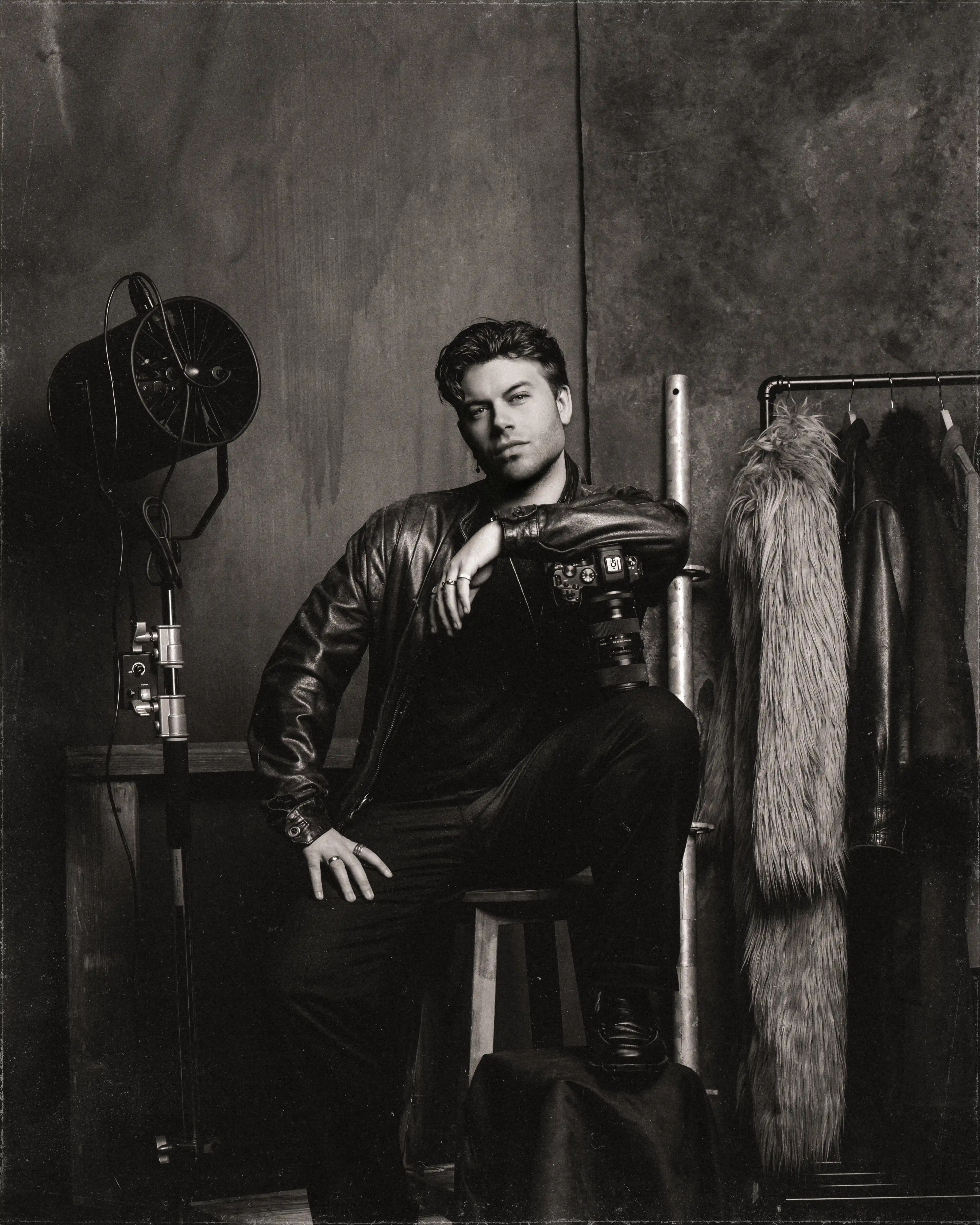
Your work often feels closer to world-building than to traditional photography. When you begin a new project, do you start with an image, an emotion, or a story?
I am obsessed with stories. I believe the words “Once upon a time…” open up a realm of possibilities that no single image could ever contain. It is this story – first imagined, then instinctively felt – that gives rise to images and, ultimately, to emotion.
This obsession guides everything I create.
I never use mood boards. I find the very idea restrictive, almost violent. I have the feeling that I become a prisoner of my own ideas – or of someone else’s.
Everything begins with a story taking shape within me. Then I share it with my collaborators through conversation, never through references or images. It is within that freedom that the most unexpected ideas emerge.
In the end, the image is a consequence of the story rather than its starting point. Above all, I seek to build a universe. Once it begins to feel almost tangible, once the characters have taken on a sufficiently clear form in my mind, the images reveal themselves naturally.
A photograph is never the story itself. It is only a fragment of it.
Before photography, you explored writing, music, and cinema. How do these disciplines continue to shape the way you build your visual narratives today?
I never felt that I abandoned writing, music, or cinema when I became a photographer. I simply changed languages.
Writing taught me how to build worlds and how to understand that a character exists far beyond what they reveal. Music taught me rhythm, silence, breathing, and the way emotion can emerge through an almost imperceptible progression. Cinema taught me light, space, staging, and perspective.
Today, each of these disciplines continues to inhabit every one of my photographs. They merge into one another. Each brings its own way of telling a story, until it becomes impossible to distinguish where writing ends, where cinema begins, or where music takes over.
Photography has simply become the place where all of these disciplines meet.
You have often said that you are fascinated by people who build something that outlives them. As an artist, what does the idea of legacy mean to you?
For me, legacy has never been about recognition. It is about permanence.
We live in an age where images are born and disappear at a dizzying pace. I often find myself wondering what truly deserves to remain.
Legacy is perhaps the only part of an artwork that completely escapes its creator. You can control an image, a project, even a career. But you can never control what time itself chooses to preserve.
Every project is an attempt to create something that is not only beautiful today, but that will still resonate years from now.
If my work ever outlives me, I hope it will not be because it bears my name, but because it continues to evoke emotions, raise questions, or inspire the imagination of people I will never have the chance to meet.
Studio Ludovic Lyne has become an extension of your creative philosophy. Beyond simply producing photographs, what vision did you want the studio to embody?
I never wanted to create just another photography studio. I wanted to create a place where ideas could take shape. A space where photography could engage in dialogue with fashion, cinema, scenography, and music, and where every project would be given the time and attention it needs to become more than just an image.
I have always felt that the places we create in profoundly influence the work that emerges from them. When building the studio, I was not simply bringing together equipment or assembling a team. I was creating an environment capable of nurturing the ambition, experimentation, and high standards that every project deserves.
Ultimately, Studio Ludovic Lyne is not the culmination of my work. It is the tool that allows me to continue this pursuit: building worlds, telling stories, and creating images that invite people to return to them.
Rather than documenting reality, your images invite viewers to imagine what exists beyond the frame. Why is this sense of ambiguity so important to the way you tell stories?
The works that leave the deepest impression on me are those that trust their audience – whether viewers, readers, or listeners. They do not try to explain everything. Instead, they leave room for the imagination to settle in.
I try to embrace that same approach in my own work. A photograph captures a single moment, yet it can suggest an entire world. What lies beyond the frame often interests me even more than what appears within it. I love the idea of an image raising more questions than it answers.
This ambiguity is not there to make an image mysterious. It is, above all, an invitation. Every viewer projects their own experiences, memories, fears, and hopes onto it. From that moment on, the image no longer belongs entirely to me – it becomes theirs as well.
Time is a recurring theme throughout your work. In your view, what allows an image to withstand the passage of time and remain emotionally relevant years later?
Time is my second obsession.
I do not believe that an image endures because of its technique or its aesthetics. Those elements evolve – sometimes very quickly. What truly withstands the passage of time is an image’s ability to continue questioning us or moving us, despite the years.
I am wary of images that strive to be contemporary. They run the risk of becoming prisoners of their own era. Instead, I try to create images that speak about deeply human experiences: identity, solitude, desire, memory, hope, the struggle against fear, the struggle against oblivion… because those emotions never grow old.
I believe that a successful photograph is not one that provides all the answers at first glance. It is one that reveals something new every time we return to it. One that evokes something different depending on who is looking at it. As long as an image is capable of creating that silent dialogue with its viewer, it continues, in its own way, to live.
A work of art does not endure because it refuses to age. It endures because it has never ceased to have something to say.
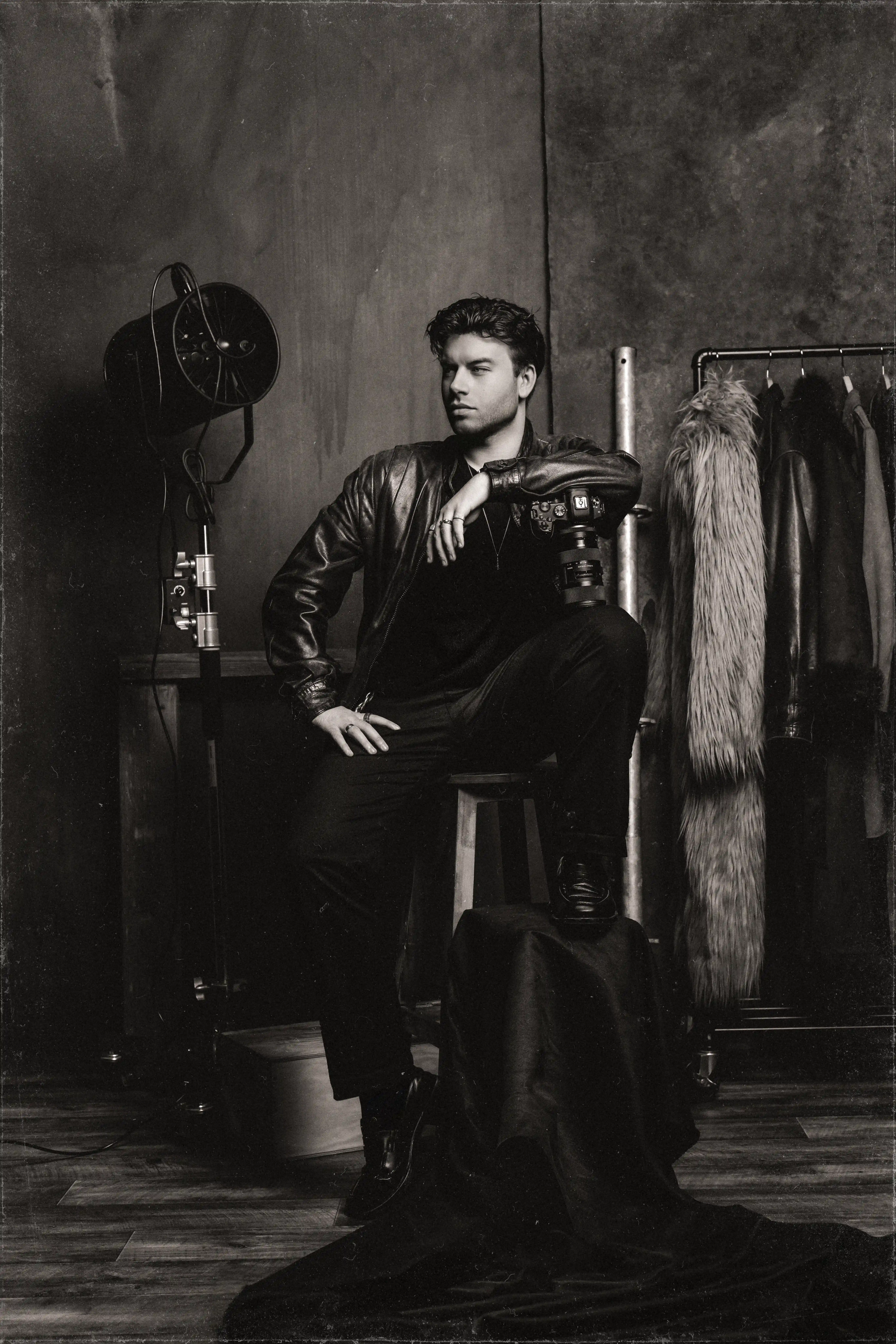
Your editorials often blur the boundaries between fashion, portraiture, and cinema. How do you find the balance between aesthetic beauty and conceptual storytelling?
I do not really see any opposition between the two. An image can be visually striking while remaining devoid of meaning, just as it can be rich in intention without ever managing to move us. To me, these are two qualities that should strengthen one another.
Aesthetics are often the gateway – they capture our attention. But they are not enough to hold it. What interests me is what happens after that first impression has faded. Does the image continue to inhabit the person looking at it? Does it leave behind a question, a feeling, an unfinished story?
So I do not try to balance beauty and narrative. I try to make beauty itself become a way of telling a story. To me, beauty only has meaning when it serves an intention.
The moment aesthetics cease to be an end in themselves and become a language, the boundaries between fashion, portraiture, and cinema almost naturally disappear.
The people you photograph become characters rather than simply subjects. How do you collaborate with them to create performances that are so emotionally charged?
I never ask someone to perform an emotion. Instead, I prefer to tell them a story, provide a context, sometimes share a few lines about the character. From there, something far more genuine can emerge.
For my new project, ARCHIVE, launched in June 2026, I wrote a one-page letter for the participants in its first edition. It was not about photography, nor about the shoot itself. It told the story of everything that came before the scene: the invisible narrative, the thoughts, the silences – everything that exists before an image is ever created.
I believe emotion cannot be directed. It must be prepared and experienced. It grows out of trust, conversation, sometimes silence, and the freedom we give someone to make the story their own.
In reality, much of this work begins long before the shoot itself. I spend an enormous amount of time choosing the people I photograph. I am not looking for someone who can play a character; I am looking for someone in whom that character already seems to exist, almost viscerally. My role is then to create the conditions that allow it to emerge.
I do not seek to impose my own vision of a character. On the contrary, the strongest images are born when fiction meets something profoundly true.
I never photograph someone for who they are. I photograph them for everything they could become.
In a world saturated with visual content and AI-generated imagery, what qualities do you believe will allow an image to remain truly unforgettable?
I do not believe an image becomes unforgettable because of the technology used to create it. No photograph has ever shaped history simply because it was technically perfect. It leaves a mark because it makes us feel something we struggle to explain.
Artificial intelligence is capable of producing extraordinary images. But producing an image and creating a work of art are two very different things.
A work of art always bears the imprint of an intention, a sensitivity, a way of seeing the world. What matters is not only what we see, but why the image exists. The creative journey is just as essential as the finished work itself. A work of art is made of questions, sketches, failures, successes, and learning.
Creating is a genuine confrontation with oneself – sometimes painful, sometimes exhilarating.
I believe we are entering an era in which rarity will no longer lie in the ability to create beautiful images, but in the ability to give them a genuine reason to exist. The easier images become to produce, the more precious their intention will become.
To me, an image becomes unforgettable when it continues to exist within us long after we have stopped looking at it. It is that lingering presence, more than its perfection, that gives it its true value.
Looking toward the future, what visual legacy do you hope your work – and Studio Ludovic Lyne – will leave on fashion photography and contemporary visual culture?
Every generation brings its own perspective, and that is what allows photography to evolve.
If my work were to leave a lasting mark, I would hope it reminds people that an image can be far more than an aesthetic exercise – that it can carry a story and build an entire universe.
I would like Studio Ludovic Lyne to be seen in that spirit. Not as a place where images are simply produced, but as a space where people still take the time to build worlds, develop ideas, and tell stories.
If, decades from now, some of my photographs continue to awaken emotions or inspire new vocations, then I will feel that I have left behind something more valuable than images alone: a way of seeing, a way of telling stories, and perhaps, a way of continuing to believe in the power of storytelling.
You often speak about building worlds that outlive their creator. Was there a particular moment in your life that led you to think differently about time, legacy, and permanence?
I have always been deeply inhabited by the idea of legacy. Since childhood, the thought of being forgotten has fascinated me just as much as it has unsettled me. From an early age, I found myself wondering what remains of a person once they are gone, and how a life can continue to exist through what it leaves behind.
Over time, I came to realize that this question runs through everything I create. I have never wanted to leave a mark out of vanity, but because I have always felt a profound need to believe that something of us can endure beyond our own existence.
If a work of art is fortunate enough to survive the passage of time, it will accompany people its creator will never meet. It is a dizzying thought, but also a deeply beautiful one.
That is probably why I build worlds rather than simply making images. A photograph can be beautiful. A world, however, can continue to be inhabited long after its creator has fallen silent.
Your work carries a sense of quiet contemplation. When you step away from the camera, what helps you reconnect with your creativity?When I feel my perspective beginning to fade, I do not try to produce more images. On the contrary, I try to step away from photography altogether. I return to writing, reading, music, or cinema because these are languages that nourish my imagination without speaking directly through photography.
I also value moments of silence. Walks with no particular destination, long periods of reflection, those moments when you stop searching for an idea and it often finds you on its own. Creativity is rarely born from constant activity. It needs time, sometimes boredom, and above all, space.
In the end, photography fills my days. Writing and composing music fill my nights. I have always felt that the hours in a single day were never enough to contain all the stories I wanted to tell. So I sleep very little – not because I am drawn to exhaustion, but because creation so often spills over into the rest of my life.
Ultimately, when I step away from the camera, I never truly step away from creating. I simply change my vocabulary.
Looking back at the young artist you were before photography became your primary language, what advice would you give him today?
I would tell him never to stop dreaming. Dreaming and daydreaming are two very different things. Daydreaming is letting your mind wander while waiting for something to happen. Dreaming is choosing a direction and accepting that it may require years – sometimes a lifetime – to pursue.
Dreams are not places of refuge. They are commitments. They demand hard work, sacrifice, failure, and the determination to remain faithful to your convictions long after everyone else has stopped understanding where you are going.
Keep believing when no one else does. Never become the man who, years later, looks back on his life wondering, “What if I had kept going?” Our greatest regrets are rarely born from our failures; they are far more often born from the dreams we abandoned too soon.
Every creator goes through periods of doubt. How do you face uncertainty while remaining faithful to your artistic vision?
I do not see doubt as an obstacle. I see it as a strength. It forces me to question my certainties, to look at my work from another perspective, and to explore paths I might never have taken otherwise.
The only thing I am careful about is ensuring that doubt remains a driving force rather than becoming a brake. As long as it pushes me to go further, to be more demanding, and to search for a truer idea, it is invaluable.
What I am far more cautious about is allowing other people’s doubts to replace my own. Personal doubt nourishes a work of art; doubt that does not belong to us often pulls us away from our own voice.
Remaining faithful to one’s vision does not mean being inflexible. On the contrary, it means constantly questioning your work without ever abandoning the reason you felt compelled to create it in the first place.
Is there a book, a film, a piece of music, or an artist that profoundly changed the way you see the world?
Many artists have profoundly changed the way I see the world. Writers, filmmakers, composers, musicians, photographers… each of them has left me with something different. Even more than shaping the way I create, they have shaped the person I have become.
Some works entered my life at pivotal moments. They built me, accompanied me, comforted me, and at times deeply moved me. Looking back, I realize they have become part of the very foundations of who I am today.
That is probably why I believe so deeply in the power of storytelling. A work of art does not necessarily change the world, but it can change the way a single person sees it. And when that perspective changes, it is already another way of existing.
I hope that one day, one of my own creations might accompany someone in that same way – just as certain works once accompanied the young man I used to be.
Success is often measured through awards and recognition. Personally, though, when do you consider a project to be truly successful?
I have been fortunate enough to receive several distinctions over the years. They have undoubtedly changed the way many people perceive my work. What they have never changed, however, is the way I perceive my art.
Awards are valuable because they represent recognition. But I do not believe they can define the worth of an artist. They reflect a particular moment, a specific context, a particular perspective. A work of art exists long before that moment, and it continues to exist long after it.
To me, a project is truly successful when it remains faithful to the story that gave birth to it. When the final image reflects the emotion, the idea, or the world I carried within me long before I ever picked up a camera.
If, years later, I can look back at it and still feel the same sense of necessity that I felt on the very first day, then I consider the project a success. Everything else belongs to the eyes of others.
If someone were to discover your work for the first time several decades from now, what emotion – or what question – would you hope stays with them long after they have closed the last image?
The last thing I would want is to define what someone should feel when encountering my work. First, because every project tells a different story. But above all because I believe there is no greater encounter with a work of art than one that is profoundly personal.
An image ceases to belong to me the moment it meets someone else’s gaze. From that instant on, it becomes intertwined with their own story, their memories, and their sensitivity. My own emotional response belongs only to me; I have no reason to wish for it to become someone else’s.
If I hope for just one thing, it is that everyone who encounters my work opens the door to their own imagination and finds within it an echo of who they are.
Beyond photography, what subject currently fascinates you or are you exploring that could eventually influence your artistic practice?
Writing and music occupy an immense place in my life. I have been writing since my teenage years, I am currently working on a novel, and music has been with me for as long as I can remember. I compose constantly. Long before photography, these two languages shaped my imagination and the man I have become. They remain, even today, at the very heart of who I am.
As far back as I can remember, I have also been fascinated by space – its silence, its vastness, its stars. That overwhelming immensity constantly reminds us how, in the end, we are nothing more than a collection of particles drifting through an almost infinite universe.
And yet, there is something about that realization that deeply moves me. Despite this sense of insignificance, human beings continue to dream, to hope, to love, and to create. It is as though, when faced with the void, our most instinctive response has always been to tell stories.
For several years now, one question has never stopped following me: Who are we?
That question runs through everything I create.
Ultimately, I do not practice several art forms because I want to explore different disciplines. I practice them because no single one is capable of expressing everything I carry within me. I feel a visceral need to give shape to whatever is born inside me. Some ideas become photographs, others become pages, and still others become music. I do not really choose their language; I simply try to listen to the one that suits them best.
Creating has never been a choice. It is the way I have found to inhabit the world.